

Cash Flow Forecasting: What Every Small Business Owner Needs
Running a small business often feels like navigating in the dark — especially when it comes to money. You might be turning a profit on paper, yet still find yourself scrambling to cover payroll or pay a supplier on time. That disconnect is exactly why cash flow forecasting matters so much. It’s not just an accounting exercise; it’s one of the most practical tools a small business owner can use to stay ahead of financial reality rather than constantly reacting to it.
This guide breaks down everything you need to know about cash flow forecasting — what it is, why it matters, and how to actually do it in a way that’s useful rather than overwhelming.
What Is Cash Flow Forecasting (And Why Should You Care)?
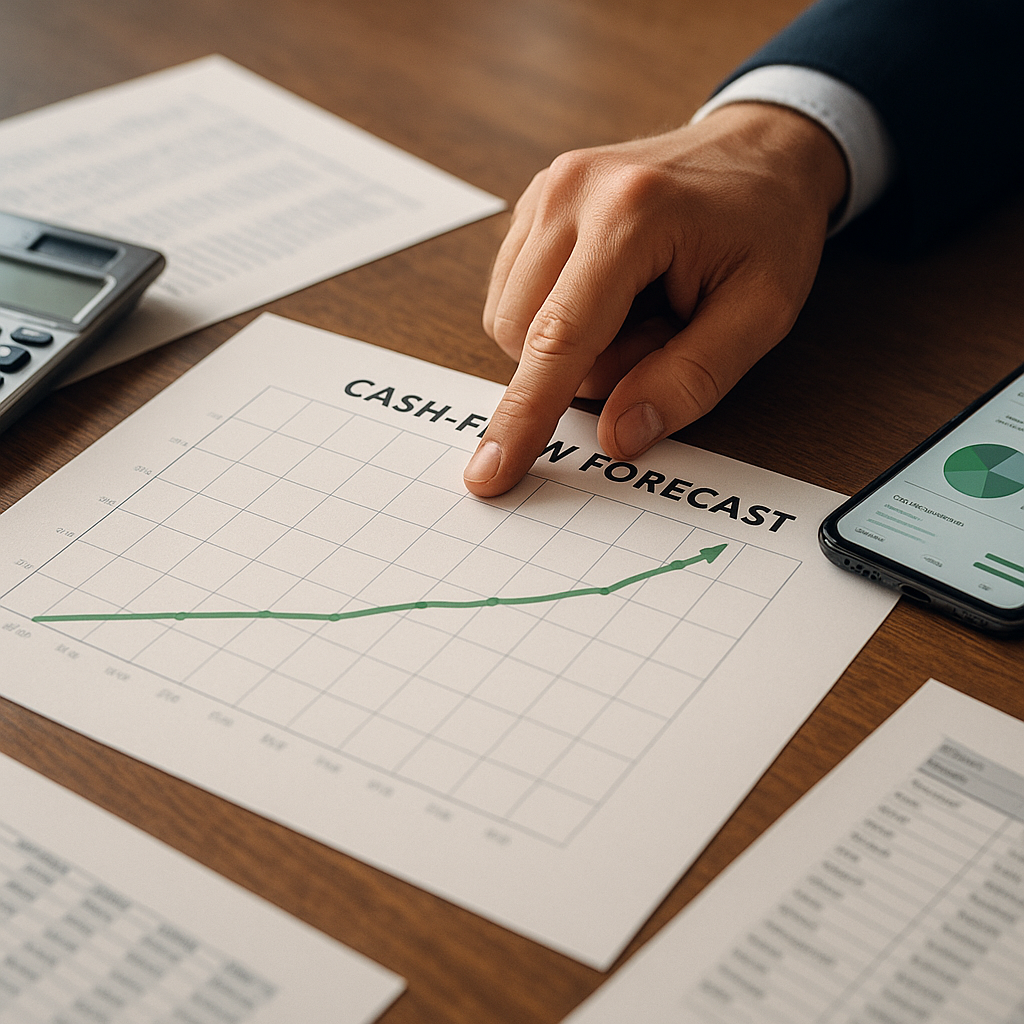
At its simplest, cash flow forecasting is the process of estimating how much money will come into and go out of your business over a specific period — usually the next 30, 90, or 365 days. Think of it as a financial weather forecast. You’re not predicting the future with perfect accuracy; you’re making an informed projection so you can prepare for what’s likely coming.
Here’s how to explain cash flow in plain terms: imagine your business is a bathtub. Revenue is the water flowing in through the tap. Expenses are the drain at the bottom. Cash flow forecasting is figuring out whether the tub will overflow, stay full, or run dangerously low — and when. If you can see a shortage coming two months in advance, you have time to adjust. If you only notice it when the tub is empty, your options shrink dramatically.
Cash flow and profit are not the same thing. A business can be profitable but still run out of cash — for example, if customers pay on 60-day terms but rent and wages are due every month. This is one of the most common — and most painful — surprises small business owners face.
The Real Cost of Ignoring Cash Flow
You may have heard the statistic that 82% of small businesses fail due to cash flow problems. That figure comes from a widely cited study by U.S. Bank and has been referenced across financial and business media for years. While interpretations vary — some failures involve both cash flow issues and underlying profitability problems — the core truth holds: poor cash visibility is one of the leading contributors to small business closures.
It’s not always about a lack of revenue. Many businesses that close were actually growing. The problem was timing — invoices not collected, inventory purchased too aggressively, or unexpected expenses hitting during a slow season. A cash flow forecast doesn’t prevent problems from occurring, but it gives you the visibility to see them forming and take action before they become crises.
Signs You Need a Cash Flow Forecast Right Now
- You’ve been surprised by a negative bank balance in the past year
- You’re not sure how much runway your business has if sales slow down
- You’re thinking about hiring, expanding, or making a major purchase
- You have seasonal revenue swings that are hard to plan around
- You’re applying for a loan or line of credit and need to demonstrate financial planning
How to Build a Cash Flow Forecast: A Step-by-Step Approach
You don’t need specialized software or an accounting degree to put together a useful forecast. A spreadsheet works perfectly well, especially when you’re starting out. Here’s a practical way to approach it.
Step 1: Choose Your Time Horizon
Most small businesses benefit from a rolling 13-week (3-month) forecast for day-to-day management, combined with a 12-month annual forecast for bigger planning decisions. The shorter the horizon, the more accurate your forecast tends to be. Start with 90 days if this is your first time — it’s manageable and immediately useful.
Step 2: List All Expected Cash Inflows
This includes everything that will actually hit your bank account — not just sales you’ve made, but payments you expect to receive. If you invoice clients on 30-day terms, a sale made in January doesn’t become a cash inflow until February. Key inflows to include:

- Customer payments (scheduled or anticipated)
- Recurring subscription or contract revenue
- Loan proceeds or investment funds
- Tax refunds or government grants
- Asset sales or one-time income
Step 3: List All Expected Cash Outflows
Be thorough here — this is where most forecasts fall short. People remember rent and payroll but forget quarterly tax payments, annual insurance renewals, or the software subscriptions that hit all at once. Common outflows include:
- Payroll and contractor payments
- Rent, utilities, and overhead
- Inventory or raw materials
- Loan repayments and interest
- Marketing and advertising spend
- Professional fees (legal, accounting)
- Equipment maintenance or purchases
- Tax payments (income, payroll, sales tax)
Step 4: Calculate Your Net Cash Flow
For each week or month in your forecast, subtract total outflows from total inflows. The result is your net cash flow for that period. Then carry the running total forward — this is your closing cash balance, and it tells you how much cash you’ll have on hand at any given point. If that number goes negative, you’ve found a problem worth planning for now.
Step 5: Review, Update, and Adjust Regularly
A forecast is only useful if it stays current. Block 30 minutes each week or at least once a month to update your actuals and revise your projections. Over time, you’ll get better at spotting patterns — slow payment months, seasonal dips, expense spikes — and your forecasts will become more accurate and more valuable.
How Much Cash Should a Small Business Keep on Hand?
A common question is: how much cash flow is actually “good” for a small business? The honest answer is that it depends on your industry, business model, and risk tolerance — but a widely accepted rule of thumb is to maintain at least three to six months of operating expenses in reserve. That’s your buffer against slow months, unexpected costs, or economic disruption.
For a business spending $20,000 per month to operate, that means keeping $60,000 to $120,000 in accessible cash. That’s not always achievable right away, especially for newer businesses — but it gives you a target to work toward as you grow. Even having one or two months of reserves changes the pressure you feel day to day.
Positive cash flow means more money is coming in than going out. In practical terms, a “good” cash flow position is one where you can meet all your obligations on time, invest modestly in growth, and maintain that reserve buffer without stress. If you’re consistently running tight, the forecast will show you exactly where the pressure points are.
Using Technology to Simplify Forecasting
For business owners who find spreadsheets tedious — or who want more automation — there are plenty of software tools designed specifically for cash flow forecasting. Platforms like Float, Pulse, Dryrun, and Futrli connect directly to accounting software like QuickBooks or Xero and can generate real-time projections without manual data entry.
If you’re curious about emerging tools, you may have wondered whether AI tools can help. AI tools like ChatGPT can assist with building a cash flow statement — for example, helping you set up a template, identify categories you might have missed, or explain accounting concepts in plain language. However, AI won’t have access to your actual business data unless you provide it, so it’s best used as a thinking partner or template generator rather than a fully automated forecasting tool.
Whatever tools you use, the goal is the same: get clarity on what’s coming so you can make proactive decisions rather than reactive ones.
Common Cash Flow Forecasting Mistakes to Avoid
Even well-intentioned forecasts can go wrong. Here are a few pitfalls that trip up small business owners:
- Being overly optimistic about revenue timing. It’s tempting to log a sale the moment the contract is signed. But cash arrives when the customer pays — not when the deal closes.
- Forgetting irregular or annual expenses. Insurance premiums, tax payments, and equipment service contracts can blow a hole in a forecast if they’re not included.
- Not accounting for late payments. If 20% of your customers routinely pay late, build that into your model. Assuming everyone pays on time is a recipe for surprise shortfalls.
- Only building one scenario. Run at least two versions of your forecast — a base case (realistic) and a downside case (what if sales drop 20%). This prepares you for the unexpected.
- Creating a forecast and never looking at it again. A forecast that isn’t maintained quickly becomes useless. Treat it as a living document.
Connecting Your Forecast to Bigger Business Decisions
One of the underappreciated benefits of regular cash flow forecasting is how much clearer it makes major decisions. Thinking about hiring a new employee? Your forecast can show you exactly how many months of additional payroll your current cash position can support. Considering a bulk inventory purchase to take advantage of a supplier discount? You’ll be able to see whether the timing works or whether it will create a squeeze elsewhere.
Forecasting also strengthens your position with lenders and investors. When you walk into a bank or sit down with a potential investor, showing a detailed, regularly updated cash flow forecast signals that you understand your business at a deep level. It builds credibility in ways that a profit and loss statement alone simply cannot. Pairing this with a broader financial planning strategy gives you an even stronger foundation for long-term growth.
It’s also worth remembering that your cash flow forecast should not exist in isolation. As your business evolves, so should your broader planning documents — revisiting your business plan regularly ensures your financial projections stay aligned with your actual goals and market conditions.
Wrapping Up: The Bottom Line on Cash Flow Forecasting
Cash flow forecasting is not a complicated skill reserved for accountants or CFOs. It’s a practical discipline that any small business owner can develop — and one that pays dividends almost immediately in terms of reduced financial stress and better decision-making.
To summarize the key points: cash flow and profit are different things, and many healthy businesses fail because they don’t manage the timing of their cash. A forecast is built by listing expected inflows and outflows, calculating net cash positions over time, and updating the model regularly. Aim to keep three to six months of operating expenses in reserve, avoid common forecasting mistakes like ignoring late payments, and use technology where it helps — while recognizing its limitations. Most importantly, treat your forecast as a living tool rather than a one-time exercise.
The businesses that survive and grow through uncertainty aren’t necessarily the ones with the most revenue. They’re the ones with the clearest picture of where their money is going — and what’s coming next.